

Business performance
analysis
See more:
Overall evaluation
General context
In 2025, the global economy continued to move cautiously amid multiple overlapping challenges, including geopolitical volatility, persistent inflationary pressures in several major economies, the restructuring of global supply chains, and tight monetary policies. In this context, businesses and organizations worldwide have become more cautious in their investment decisions, prioritizing efficiency, profitability, and long-term sustainability. New opportunities emerged as the wave of digital transformation, along with the adoption of AI, automation, and big data, continued to accelerate to improve productivity, optimize costs, and strengthen competitiveness. Technology, particularly AI, has moved from the experimentation stage to practical deployment, creating increasingly clear demand for solutions capable of delivering tangible value to business operations.
Vietnam’s economy continued to maintain growth momentum, supported by macroeconomic stability, flexible policy management, and the recovery of manufacturing, exports, and domestic consumption. Government stepped up the implementation of policies to support businesses and improve the investment environment, while also promoting the development of the private sector as a key driver of growth. Notably, Resolution No. 57-NQ/TW on the development of science and technology, innovation, and national digital transformation has created a favorable policy framework for the application of technology, AI, and data across both the public and private sectors. This provides an important foundation for increasing demand for comprehensive technology solutions, opening long-term growth opportunities for companies with strong technological capabilities and established market credibility.
In this context, FPT continued to affirm its position as a leading technology company, proactively adapting to changes in both the global and domestic business environments. FPT focused its resources on core technology areas, including AI, digital transformation, semiconductors, digital automotive technology, and digital infrastructure, while gradually optimizing its business portfolio to enhance efficiency and the quality of growth. FPT has adopted AI not only for new product and service development but have also widely applied it in internal operations, project management, and process optimization, which has enhanced labor productivity and overall competitiveness. FPT remains committed to its sustainable development strategy, balancing expansion with improved capital efficiency, and steadily building long-term competitive advantages in an increasingly competitive landscape.
Business results
In 2025, the global economy encountered more unpredictable fluctuations than initially anticipated when setting the business plan at the year’s start, especially due to trade tensions and U.S. tariff policies. Despite these challenges, FPT sustained double-digit growth and stayed close to its original business objectives. Revenue reached 93% of the plan and profit before tax achieved 97% of the target. Profit after tax attributable to shareholders of the parent company and earnings per share (EPS) reached 98% and 100% of the plan, respectively. These results demonstrate FPT’s flexible management capability and its ability to respond promptly to the market’s unpredictable changes.
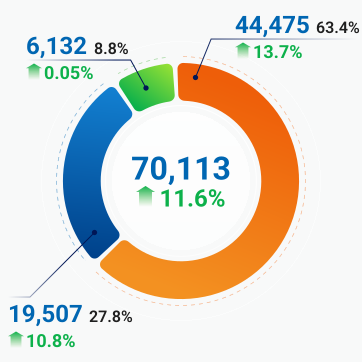
Revenue structure by sector
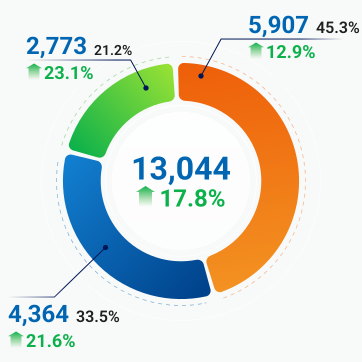
Pre-tax profit structure by sector
- Technology
- Telecommunications
- Education, Investment, and Others
- Unit: Billion VND
The IT services for foreign markets segment, the main growth driver of FPT, continued to maintain strong growth compared with the industry average, up 14.3% year-on-year. This performance was driven by increasingly clear demand for digital transformation and AI adoption in the Japanese market, which recorded a growth of 25.4% compared with the previous year. Focusing on large-scale, long-term and high value-added technology contracts has enabled FPT not only to expand its revenue base but also to progressively enhance the quality of growth and overall business efficiency. In a context where the global IT services industry remains cautious, with many large IT services companies worldwide, including those in India, reporting only modest growth, FPT’s results partly reflect its continuous efforts to expand markets, diversify its service portfolio, and maintain stable development momentum.
Within this sector, Digital transformation services continued to record strong growth of 16.8% year-on-year, accounting for an increasing proportion of revenue from IT services for foreign markets (47.3%). Solutions related to data, cloud computing, AI, and automation were increasingly deployed by clients to improve operational efficiency and strengthen competitiveness. These results not only reflect the strong shift toward next-generation digital transformation but also affirm FPT’s position and capability in delivering advanced technology services in the foreign market.
Alongside its business activities, FPT continues to broaden and deepen its strategic collaboration with leading global partners. Such cooperation goes beyond service provision and has gradually expanded to include co-development of solutions, technology transfer, and long-term capability building, strengthening FPT’s role in the global technology value chain.
By proactively applying technology, particularly AI, to optimize operations and management, the Telecommunications sector and Education, Investment and Others sector continued to maintain stable growth. The Telecommunications segment (revenue growth of 10.8%) focused on improving service quality and customer experience, while expanding infrastructure coverage and its product portfolio, gradually strengthening its market presence and improving market share in key segments. Meanwhile, the Education segment concentrated on enhancing training quality and aligning more closely with workforce demand in strategic technology fields prioritized by Government, including AI, semiconductors, data, cloud computing, information safety and security, as well as technologies supporting digital and green transformation. This direction helps reinforce FPT’s role in providing high-quality human resources for the digital economy.
Key business performance indicators in 2025
| Indicator | 2024 | 2025 | +/- |
|---|---|---|---|
| Total assets | 72,000 | 88,142 | 22.4% |
| Revenue | 62,849 | 70,113 | 11.6% |
| Profits from business operations | 11,025 | 12,952 | 17.5% |
| EBITDA | 13,605 | 15,958 | 17.3% |
| Profit before tax | 11,070 | 13,044 | 17.8% |
| Profit after tax | 9,427 | 11,232 | 19.1% |
| Earnings per share (Unit: VND) | 4,292 | 5,216 | 21.5% |
| Cash dividends | 2,741 | 3,185 | 16.2% |
| Dividend payout ratio | 34.9% | 34.0% | -90bps |
(Unit: Billion VND)
Key financial ratios
Liquidity ratios
The current ratio and quick ratio continued to improve, reaching 1.40 times and 1.35 times, respectively. Both ratios remained at a safe level above 1.0 and increased compared with the previous year, reaffirming FPT’s solid financial foundation and effective cash flow management. Stable liquidity provides important room for FPT to proactively accelerate investments in strategic areas, thereby strengthening long-term competitiveness.
Capital structure ratios
FPT has proactively increased its technological investments, particularly in computing infrastructure and the AI solutions ecosystem, to ensure the capability to deliver large-scale projects globally. Accordingly, the debt-to-total assets and debt-to-equity ratios rose to 23.9% and 48.2%, respectively, reflecting a strategy of using financial leverage at a prudent level to support growth. Notably, FPT continued to maintain a positive net cash position, ensuring financial safety and preserving capital capacity for strategic investment opportunities in the future.
Operating efficiency ratios
Operational efficiency continued to be maintained at a high level. Inventory turnover increased, reaching 20.5 times, indicating more effective inventory management. Receivables turnover remained stable, while payable turnover improved, reflecting more efficient working capital management. The cash conversion cycle stood at 49.0 days, remaining stable as FPT expanded its scale and increased investments, thereby ensuring smooth and sustainable business operations.
Profitability ratios
Profit margin indicators continued to improve compared with the previous year. Operating margin reached 18.5%, profit before tax margin reached 18.6%, and net profit margin reached 16.0%, reflecting FPT’s effectiveness in improving revenue quality and optimizing costs. These results also indicate FPT’s strong shift toward higher value-added segments with greater technological content. Return on equity (ROE) reached 28.1%, remaining at an attractive level as FPT proactively expanded its asset base and increased investment in core technology platforms. Return on assets (ROA) and return on invested capital (ROIC) declined slightly compared with the same period last year, in line with the long-term investment strategy aimed at building a foundation for sustainable growth and reinforcing FPT’s position in the new technology cycle, particularly in AI.
