

Business strategy
General Context
Growth in IT services spending
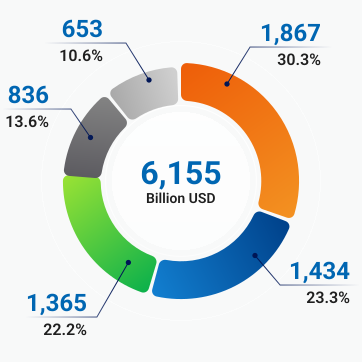
Global IT spending is projected to reach 6,155 billion USD in 2026, an increase of 10.8% compared to 2025 (Source: Gartner). Spending growth is particularly strong in data centers (up 31.7%) and software (up 14.7%), driven by the demand for computing infrastructure to support AI. IT services spending is forecast to reach 1,867 billion USD in 2026 with a growth rate of 8.7%, making it the largest segment of global IT spending. This reflects the increasing demand for consulting, implementation, system modernization, digital transformation, and AI adoption across enterprises.
Global IT spending 2026
- IT Services
- Software
- Communications Services
- Devices
- Data Center System
- Unit: Billion USD
- (Source: Gartner)
- IT Services
- Software
- Communications Services
- Devices
- Data Center System
- Unit: Billion USD
- (Source: Gartner)
AI entering a value-creation cycle, becoming a new driver for long-term growth
A Gartner survey indicates that over 80% of Chief Information Officers (CIOs) intend to substantially boost their investments in core capabilities like cybersecurity, generative AI, and data governance. During the 2025-2026 period, CIOs are shifting their focus from pilot projects to initiatives that deliver tangible value and measurable returns from AI, particularly Agentic AI. In this context, A.R.T (Agile Realignment – Risk Readiness – Tenacity) represents a set of three core capabilities that enable organizations and enterprises to grow and achieve breakthroughs in an increasingly volatile world driven by AI.
- Agile Realignment: 94% of CIOs expect significant changes in IT project spending plans over the next 24 months and are willing to discontinue underperforming projects to reallocate resources toward AI initiatives;
- Risk Readiness: CIOs are shifting from a “borderless vendor” strategy toward prioritizing regional partners and digital sovereignty solutions (Geopatriation) to mitigate geopolitical risks and comply with increasingly stringent data regulations;
- Tenacity in financial outcomes: CIOs’ top priority is to translate AI-driven productivity into tangible financial results by optimizing operating costs and driving revenue growth.
A notable trend is the increasing preference for open-source AI models. 76% of enterprises using large language models (LLMs) prioritize open-source models, combined with proprietary solutions, to optimize costs, performance, and data control. The proportion of enterprises investing in developing their own AI models has declined sharply, from 43% in 2024 to 24% in 2025. This trend opens up opportunities for technology companies such as FPT Corporation to develop AI platforms based on open-source technologies and build specialized AI solutions, creating room for sustainable growth in the medium and long term.
Generative AI spending for the period 2024-2025
Generative AI spending
for the period 2024-2025
- 2024
- 2025
- Unit: Billion USD
The trend of adopting open-source AI models is demonstrated across several key economic sectors. The industrial and automotive sectors are leading in the use of open-source large language models to optimize supply chains, enhance quality control, and improve operational efficiency. Within these sectors, the deployment and use of natural language processing (NLP) solutions have seen a 148% year-on-year increase. Meanwhile, the financial services sector leads in the adoption of “serverless” architecture, a cloud computing model that allows developers to build and run applications without managing physical or virtual server infrastructure, with an increase of 131%.
Alongside the trend of infrastructure optimization and flexible AI deployment, Agentic AI is emerging as a new growth driver of the market, reaching a value of 7.3 billion USD in 2025 and projected to grow from 9.1 billion USD in 2026 to 139.2 billion USD by 2034. This trend reflects a strong shift toward systems capable of autonomously executing tasks with minimal human intervention, reshaping how enterprises operate from process automation to intelligent decision support.
In the rapidly expanding autonomous AI market, global AI spending is also experiencing strong growth. According to Gartner, global AI spending reached approximately 1,757 billion USD in 2025, an increase of more than 50% compared to 2024, and is expected to reach 3,335 billion USD by 2027.
AI spending 2025-2027
| Market | 2025 | 2026 | 2027 |
|---|---|---|---|
| AI Services | 439 | 588 | 761 |
| AI Cybersecurity | 26 | 51 | 86 |
| AI Software | 283 | 452 | 636 |
| AI Models | 14 | 26 | 43 |
| AI Platforms for data science and machine learning | 22 | 31 | 44 |
| AI Application development platforms | 7 | 8 | 11 |
| AI Data | 0.8 | 3 | 6 |
| AI Infrastructure | 965 | 1,366 | 1,748 |
| Total AI spending | 1,757 | 2,525 | 3,335 |
(Unit: Billion USD)
Transformation of the IT services industry: New risks and opportunities from AI
The rapid rise of AI delivers significant productivity gains, but it also presents the IT services industry with new challenges related to business models and value creation approaches. According to a report by J.P.Morgan Chase, IT services companies are facing pressure to “re-prove” their value in an increasingly uncertain environment.
- Risks related to pricing models and shifts in revenue structure: The IT services industry has traditionally operated under a Time & Material pricing model. However, the automation and optimization capabilities of AI are directly challenging this model. As AI-powered tools increase labor productivity by 30-50%, the number of billable hours required for the same volume of work will decline significantly. As a result, companies that fail to transition in time to outcome-based or subscription-based pricing models may face the risk of revenue decline;
- P*Q dynamics and the risk of budget fragmentation: J.P.Morgan Chase highlights a paradox: although the price per unit of work (P) may decline due to AI, overall IT spending can remain stable thanks to rising demand (Q) to address technical debt, estimated at 8,000 billion USD. However, risks arise from the growing “save-to-reinvest” trend, where clients pause non-essential projects to reallocate budgets toward AI initiatives, creating short-term challenges for the growth of IT services companies;
- Challenges in governance, compliance, and trust: Deploying AI at scale requires robust governance frameworks to ensure data security, transparency, and the reliability of algorithms. This means that IT companies must not only possess strong technical capabilities but also act as advisors on AI-related legal and ethical issues.
Conversely, the rapid wave of AI adoption is opening new growth opportunities, driven by the rise of AI engineers and the Agent Operations (AgentOps) operating model. According to Gartner, by 2028 the demand for AI engineers is expected to significantly exceed the demand for traditional programmers as the focus of work shifts toward orchestrating multi-agent AI systems and managing AgentOps models.
At the same time, the ability of AI to reduce software development costs is encouraging enterprises to expand the scale of their applications and develop more intelligent software solutions to address business challenges. This creates significant opportunities for legacy system modernization projects and the development of AI-integrated Intelligent Apps. In this context, the competitive differentiation of technology companies is no longer based solely on coding capabilities but increasingly on their ability to understand business contexts, industry-specific requirements, and provide comprehensive solution consulting.
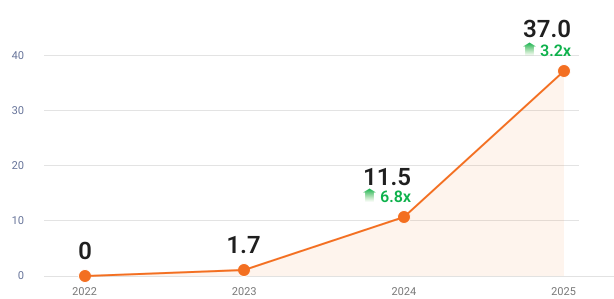
A report by Gartner indicates that the global enterprise AI market expanded 3.2 times, from 11.5 billion USD in 2024 to 37 billion USD in 2025, becoming the fastest-growing segment. Notably, the number of AI models deployed directly in operational environments to support business operations and decision-making increased 11 times year-on-year, reflecting the growing maturity of large-scale AI deployment capabilities.
Enterprise AI market size
(Unit: Billion USD)
*Source: Gartner
Geopolitical conflicts and trade tensions reshaping the global technology value chain
Rising geopolitical tensions are creating deep divisions in global technology trade. In an increasingly multipolar world, countries are striving to reduce dependence on foreign technology platforms through comprehensive infrastructure strategies.
Semiconductors have become the “oil of the 21st century,” accelerating the localization of supply chains across regions. The U.S CHIPS and Science Act reflects the strategy to reduce dependence on China while accelerating the race in AI, biotechnology, and semiconductor technologies. The United States has imposed export restrictions on advanced telecommunications equipment and semiconductor technologies, including chips manufactured abroad using U.S. technology. These measures have triggered a profound restructuring of the global semiconductor industry.
AI is increasingly viewed as a source of national power. Countries are investing heavily in sovereign computing infrastructure and AI models built on domestic data. South Korea launched the AI Champions initiative valued at 530 billion won to develop domestic large language models such as HyperCLOVA X by Naver and EXAONE by LG, aiming to reduce reliance on OpenAI and Google. Canada has committed 2 billion USD to its sovereign AI computing strategy. The government of Japan is supporting the development of LLMs focused on the Japanese language and specialized industrial data to safeguard cultural identity and data security. Meanwhile, India has launched the IndiaAI Mission, valued at 1.25 billion USD, to strengthen domestic AI computing capabilities.
This evolving context creates strategic opportunities for Vietnam. As multinational corporations diversify their supply chains, Vietnam with its stable geopolitical position, young technology workforce, and open economic policies, has become an increasingly attractive destination. The “China+1” trend in technology supply chains opens new opportunities for Vietnamese technology companies to integrate more deeply into the global technology value chain.
Studies indicate that rising geopolitical tensions are limiting the scope and depth of digital technology adoption, particularly within state-owned enterprises. This trend highlights the urgent need for digital sovereignty and stronger capabilities in mastering core technologies.
Meanwhile, the rapid advancement of quantum computing is posing significant risks to current cryptographic systems, which may become vulnerable to large-scale breaches in the future. In response, the concept of “quantum sovereignty” is gradually emerging, emphasizing the need to develop and control next-generation security protocols, including cryptographic systems that conventional methods and post-quantum cryptography (PQC) can not break. In addition, many countries are tightening regulations on digital identity and data localization, aiming to strengthen control and ensure cybersecurity in the digital.
Vietnam’s policy breakthrough: Science, technology, innovation, and digital transformation as pillars of development
In Vietnam, the Government has introduced a range of policy measures to enhance data governance, including data cleansing, digital identity authentication, and strengthened cybersecurity and information security frameworks. Major domestic technology conglomerates will implement large-scale national projects, particularly in strategic technology sectors, due to government encouragement.
Science, technology, innovation, and digital transformation have been identified as one of the eight key pillars of development in the documents of the 14th National Congress of the Communist Party of Vietnam. These areas are regarded as critical drivers of long-term economic growth. Beyond improving productivity and national competitiveness, they also serve as essential tools for enhancing governance efficiency, strengthening technological self-reliance, safeguarding national defense and security, and fostering new business models, employment opportunities, and value creation within the economy.
Resolution No. 57-NQ/TW on breakthrough development in science, technology, innovation, and national digital transformation sets out an ambitious vision: positioning Vietnam among the top three countries in ASEAN and the top 50 globally in digital competitiveness, while also ranking among the top three in ASEAN in artificial intelligence research and development by 2030. Notably, the Resolution commits to allocating at least 3% of the national budget annually to science, technology, and digital transformation, with the allocation expected to increase over time in line with development needs.
To operationalize this vision, several key targets have been identified, including nationwide 5G coverage, the completion of smart city deployment in centrally governed municipalities, and the attraction of three leading global technology organizations to establish headquarters and R&D centers in Vietnam. In parallel, the Politburo has also emphasized assigning large domestic corporations to lead national-scale digital transformation projects, thereby fostering the emergence of leading technology enterprises capable of driving the innovation ecosystem and integrating more deeply into global value chains.
Additional resolutions (Resolutions No. 66-NQ/TW, 71-NQ/TW, and 72-NQ/TW), together with newly introduced laws, including the Law on Digital Technology Industry, the Law on Science, Technology and Innovation, and the Law on High Technology, as well as Decision No. 1131/QĐ-TTg, establish a legal framework for experimenting with digital products in controlled regulatory environments (sandboxes), developing national digital platforms, and advancing strategic technologies such as artificial intelligence (AI), big data, cloud computing, IoT, blockchain, and virtual reality.
A notable milestone in 2025 is the inclusion, for the first time, of the principle of “technological mastery and self-reliance” in the Law on High Technology as a core criterion for eligibility for policy incentives. Experts widely regard this as a significant shift in policy thinking. This shift aims to address the long-standing reliance on externally transferred technologies, a structural constraint that has historically limited value creation and increased the economy’s vulnerability to global shocks.
Under the new development orientation, strategic technologies are identified as key enablers for strengthening national technological autonomy and global competitiveness. Fields such as AI, big data, semiconductors, cybersecurity, green technologies, and new energy technologies are seen not only as engines of economic growth but also as critical components of economic security and sustainable development. The government has affirmed its commitment to mobilizing national resources to invest in, develop, and progressively master these technologies, positioning them as pillars of a knowledge-based growth model.
