

Business strategy
FPT’s development strategy for the 2026-2028 period
AI-First
In the new technological era, an AI-First approach has become a prerequisite for enterprises to survive and achieve breakthrough growth. Data from McKinsey & Company indicate that companies leading in comprehensive AI integration report 15% higher revenue and 20-25% improvements in operational efficiency compared to their competitors. For FPT Corporation, this trend requires a strategic transition from a traditional IT service delivery model toward an AI-native platform model, in which AI is embedded across all solutions and operational processes.
The market for autonomous AI systems is projected to grow from 5.1 billion USD in 2024 to 47.1 billion USD by 2030, reflecting a strong shift toward systems capable of executing complex tasks with minimal human intervention. In response, FPT is prioritizing the development of specialized AI Agents for key industries such as finance, manufacturing, healthcare, and logistics. These AI-driven systems enable clients to automate workflows, enhance decision-making processes, and optimize operational resources. In parallel, leveraging its large-scale internal training ecosystem across multiple skill levels, FPT is rapidly expanding its AI engineering workforce to meet the growing demands of AI research, development, and large-scale orchestration of AI Agents.
An open-source model collaboration strategy also plays a critical role in balancing cost efficiency and technological control. Approximately 76% of enterprises adopt open-source AI models, combining them with proprietary solutions to optimize performance while maintaining control over data and infrastructure. For FPT, this strategy involves building an integrated AI platform that combines open-source models such as LLaMA and Mistral with FPT’s proprietary technologies. This approach is expected to create a sustainable competitive advantage in delivering customized AI solutions for the Vietnamese and regional markets.
In 2025, FPT significantly increased its investment in developing an AI ecosystem and integrating AI across its business operations, production, and service offerings. The company’s AI ecosystem is gradually taking shape, supported by high-performance computing infrastructure through AI Factory facilities in Vietnam and Japan, alongside key platforms such as FPT.AI, FPT AI Agents, and FleziPT.
Earlier, FPT also commenced construction of the Artificial Intelligence Center and Supporting Urban Area, with a total investment exceeding 4.3 trillion VND. More than a technology hub, the project is designed as an integrated environment combining research, education, deployment, and supporting urban infrastructure. This reflects a strategic vision that treats AI not merely as a technology but as a complete industry ecosystem, closely linked with talent development, global expert attraction, and the formation of an innovation-driven community.
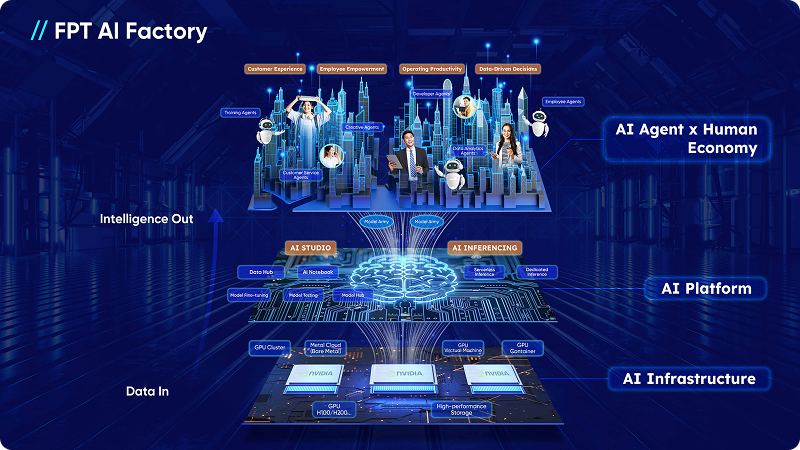
In the next phase, FPT will continue to invest significantly in the following areas:
- Expanding and enhancing the AI ecosystem, including AI Studio, AI Inferencing, AI Agents, and advanced data platforms designed to accelerate AI application development. At the same time, FPT will continue investing in data center infrastructure and strengthening its AI computing capabilities;
- Comprehensively adopting the flexible AI platform FleziPT, which is built upon methodologies, processes, and solutions that have been validated through real-world deployments. The platform is continuously refined through the implementation of AI projects, ensuring adaptability and evolution in response to changing customer and market demands. FleziPT represents the accumulation and standardization of FPT’s AI implementation experience, designed to deliver superior value to clients. Architecturally, FleziPT follows a multi-layered model, with its core capability layer consisting of Flezi Workforce and Flezi Foundation, which integrate proven practices, tools, methodologies, and resources, including both human talent and digital workforce, validated through practical project execution;
- Developing AI applications, customized large language models (LLMs), and sector-specific products and services in specialized domains such as healthcare, pharmaceuticals, finance and insurance, human resource management, and education and training;
- Implementing co-investment partnership models to develop breakthrough AI-driven solutions that enhance customers’ business performance and operational efficiency;
- Applying AI to improve internal operational productivity, particularly in software development and system management. These initiatives aim to accelerate product development cycles, enhance workforce productivity, and enable early detection of errors and service issues;
- Expanding strategic technology partnerships following existing collaborations in high-performance computing infrastructure. FPT plans to broaden its core technology ecosystem and industry-focused AI solutions through partnerships with international enterprises and startups developing specialized AI products and platforms, such as LandingAI and Agora Inc.. In the coming phase, the focus of collaboration will extend beyond technology integration toward joint research, development, and commercialization of industry-specific AI platforms and applications, particularly in sectors such as finance and banking, manufacturing, and services. This approach will enable FPT to accelerate access to emerging technologies, strengthen its capability to master core technologies, and enhance value creation within the global AI supply chain.
Mastering strategic technologies to strengthen digital sovereignty
Amid escalating geopolitical tensions, digital sovereignty has emerged as a national security priority. Research from the Federal Reserve Bank of St. Louis shows that technology restrictions have caused significant fragmentation in global supply chains, prompting countries to strengthen domestic technological capabilities. In Vietnam, Resolution No. 57-NQ/TW sets the direction for rapid and sustainable development based on science and technology, innovation, and digital transformation, while progressively enhancing national technological self-reliance, particularly in strategic technologies. The government prioritizes national resources for the development of core technologies, critical digital infrastructure, and the domestic digital technology enterprise ecosystem. The Resolution also underscores the need to safeguard national sovereignty in cyberspace, strengthen cybersecurity, data security, and information safety, creating long-term development opportunities for technology companies capable of delivering foundational platforms and security services.
According to Boston Consulting Group (BCG), AI-First companies do not merely adopt AI technologies but fundamentally reorganize their entire organizations around AI, from core technological capabilities and product strategies to corporate culture and talent development. This transformation requires FPT Corporation to invest in core technology platforms, develop internal capabilities, attract global talent, expand training programs, and build a strong ecosystem of strategic partners.
Strategic technology areas and FPT’s targets for 2026-2030:
Artificial Intelligence
- Achieve full mastery across the AI value chain, spanning models, data, computing infrastructure, applications, and talent development;
- Model and data capabilities: Develop and own leading multimodal foundation models in Vietnam, Japan, and Southeast Asia, while establishing dedicated laboratories for AI safety and evaluation to ensure responsible AI deployment;
- Infrastructure: Operate an AI Factory in Vietnam with a total computing capacity of approximately 10 EFLOPS (FP8);
- AI applications: Promote large-scale AI adoption by providing AI education for at least 20 million users, deploying AI solutions in traffic management across three major cities, and supporting the operation of smart city command centers in centrally governed municipalities;
- AI workforce development: Incubate 1,000 AI startups and provide AI skills training for approximately 500,000 individuals.
Quantum technology
The Quantum AI & Cybersecurity Institute aims to train 100 PhD-level researchers, develop and upskill 2,000 high-level technology experts, and produce 500 scientific publications, patents, and valuable intellectual property assets.
Cloud computing and Edge computing
Establish a leading position in the domestic cloud market, becoming a key pillar of Vietnam’s digital infrastructure. Building on its proven capabilities, FPT will expand the FPT Cloud service ecosystem to regional markets, starting with ASEAN, gradually integrating Make-in-Vietnam Cloud and AI infrastructure into regional technology value chains. In terms of human resources, the target is to train 1,500 cloud engineers and 200 senior cloud architects.
Chips and product design (hardware/software)
Expand mastery across additional semiconductor product lines in higher-value segments, focusing on fast-growing and strategically advantageous areas such as signal processing chips for healthcare, drones, cameras, humanoid robots, and other intelligent systems. The FPT education system aims to train 10,000 semiconductor professionals by 2030, directly contributing to Vietnam’s national goal of developing a strong semiconductor engineering workforce.
Cybersecurity
Establish a leading position in Vietnam’s cybersecurity market with an integrated suite of Made-by-Vietnam cybersecurity solutions, designed to protect critical digital infrastructure, national data systems, and high-security information environments.
Unmanned Aerial Vehicles (UAV)
Adopt a platform-centric approach, suitable for rapid and flexible development across multiple hardware platforms in the early stages, while reducing the risks associated with dependence on a single supplier. By 2028, the priority objective is to establish system-level UAV operational capabilities, including pilot programs for flight management models, certification and licensing mechanisms, and monitoring systems. This strategy also involves developing core digital platform layers and gradually reducing supply chain dependency through controlled localization.
Blockchain, one of the key pillars of the Web3 economy
FPT aims to master and further develop core blockchain technologies, while progressively establishing Web3 standards aligned with Vietnam’s legal, governance, and development context. Alongside technological development, FPT seeks to deploy “Make in Vietnam” blockchain and Web3 platforms in practical applications across various localities and organizations nationwide, while gradually expanding into international markets. By 2030, the platforms developed by FPT are on course to be implemented in approximately 10 provinces and cities and adopted by more than 200 domestic enterprises, while also being exported and piloted or commercially deployed in at least five countries.
Digital transformation for Government and local authorities: A key market
FPT Corporation views digital transformation in the public sector as a key growth driver over the next three to five years.
The Vietnamese government has approved the National Digital Transformation Program for the 2025-2030 period, aiming for 100% of public services to be delivered online at level 4 by 2030. In addition, the government has adopted a policy to allocate 2% of the annual state budget to technology, information technology, and innovation.
In 2025, FPT collaborated with multiple ministries, government agencies, and local authorities to develop data strategies, digital transformation strategies, and digital government architectures for the 2026-2030 period.
Moving forward, FPT will continue partnering with the government:
- Develop and operate national and sectoral databases, ensuring data quality standards described as “accurate, complete, clean, and continuously updated”, which serve as the foundation for convenient and effective digital public services for citizens;
- Integrate AI and big data analytics to automate administrative procedures, reduce processing time, and improve the overall citizen experience;
- Develop digital platforms and digital initiatives that integrate AI technologies to effectively leverage national and sectoral databases, thereby enhancing public sector governance capabilities;
- Accelerate the adoption of IoT, AI, and Big Data in major urban areas to optimize traffic management, energy usage, and public security, moving toward the development of smart city models;
- Collaborate in developing and operating innovation initiatives based on digital technology platforms, leveraging AI applications to support economic development and improve citizens’ quality of life;
- Support the development of a future-ready workforce by providing training programs that equip local human resources with the skills required to implement breakthrough policies in science and technology, innovation, and strategic technologies at the local level.
As a technology services enterprise operating in more than 30 countries, and a strategic and premier partner of many leading global and regional technology corporations, FPT Corporation possesses strong advantages in connecting with the global technology ecosystem and mobilizing a highly skilled workforce. This capability enables FPT to effectively leverage international resources, technologies, and expertise to directly support public sector digital transformation and smart city development in Vietnam. Through these efforts, the company contributes to advancing the national goals of building a digital government, digital economy, and stronger technological self-reliance.
Innovation and expansion in Education
The FPT Education system, one of the largest education networks in Vietnam in terms of student enrollment from primary and secondary education to undergraduate and postgraduate levels, is undergoing a strategic transformation to become a key talent pipeline for national strategic technology sectors.
- Advanced research-oriented university education: FPT aims to develop its universities following a high-quality practice-oriented research model. A key initiative is the introduction of early mentorship programs starting from the second year, connecting students directly with leading experts within the FPT ecosystem to help shape their professional capabilities and accumulate practical experience early on. Faculty members and students are encouraged to participate deeply in real-world R&D projects within enterprise environments, such as those at the Quantum AI & Cybersecurity Institute (QACI) and FPT Semiconductor, thereby narrowing the gap between academic knowledge and real-world applications in chip design AI, and cybersecurity;
- AI education from the school level: Rather than being taught as a standalone subject, AI is integrated into three core pillars: STEM, Coding, and Robotics, to equip students with the ability to understand, formulate, and solve problems using technology. Starting in 2026, FPT plans to develop an AI-powered educational platform to support the implementation of the flipped classroom model, initially piloted in selected grades and subjects. This AI-enabled flipped classroom approach reflects a philosophy of active learning, in which AI is used responsibly, purposefully, and under appropriate guidance and supervision;
- Expanding scale and academic disciplines: FPT will continue expanding its nationwide network of schools to attract young talents across Vietnam. At the same time, the education system will broaden its academic programs to align with the country’s strategic technology value chains, including semiconductor design, quantum technology, cybersecurity, and unmanned aerial vehicles (UAVs).
Plan for 2026
For the 2026 figures, FPT consolidates FPT Telecom Joint Stock Company using the equity method; the 2025 figures have been adjusted using the same method to ensure consistency and comparability.
Revenue by sector
- 2026
- 2025
- Unit: Billion VND
- 2026
- 2025
- Unit: Billion VND
Pre-tax profit by sector
- 2026
- 2025
- Unit: Billion VND
- 2026
- 2025
- Unit: Billion VND
Expected investment plan
Expected investment plan
| Sector | Investment budget | Notes |
|---|---|---|
| Technology | 4,200 | Investing in expanding office complexes in major cities such as Hanoi, Ho Chi Minh City, Binh Dinh. |
| Education, Investment, and Others | 3,000 | Focusing on expanding university campuses in major locations like Hanoi, Ho Chi Minh City and Da Nang, alongside establishing new training facilities in various provinces and cities nationwide. |
| Total | 7,200 |
(Unit: Billion VND)
